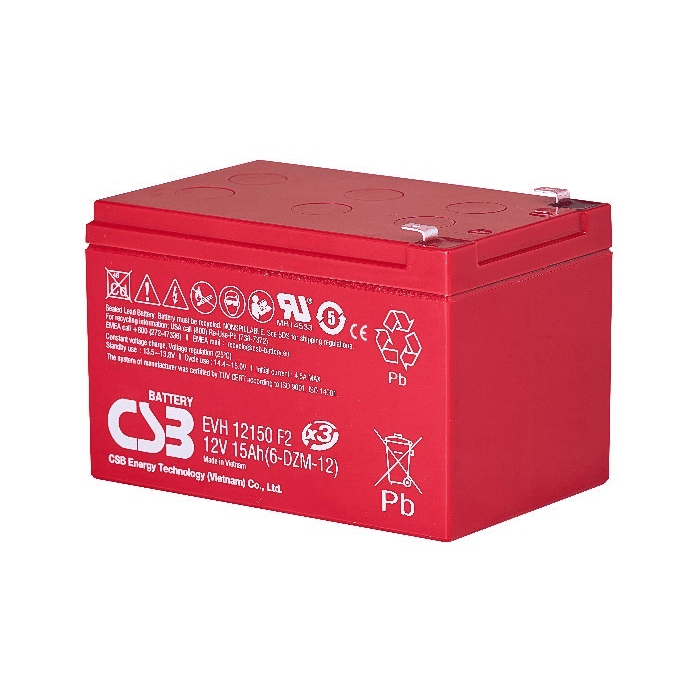
CSB EVH12150 VRLA Battery 12V 15Ah (EVH Series)
The CSB EVH12150 from the EVH series is a 12V valve-regulated sealed lead-acid battery with a 20-hour rate nominal capacity of 15Ah. Built with AGM technology and a pure lead construction, it meets the demands of electric mobility and deep cycle applications, with a design cycle life of 450 cycles at 100% DOD and 25°C.
Taobao store
WeChat procurement
Product Features
- Valve-regulated lead-acid (VRLA) design
- Absorbent glass mat (AGM) technology, maintenance-free, with up to 99% gas recombination efficiency
- Pure lead plates with proprietary formulation elements
- Built for electric mobility and deep-cycle applications
- Manufactured to IEC 60254-1:2005 / IEC60254-2:2008 and UL1989 certified (MH14533)
Application Scenarios
- Electric wheelchairs and mobility scooters requiring frequent charge and discharge
- Power batteries for shared electric scooters
- Deep-cycle power supplies for electric assist bicycles
- Battery packs for golf carts and campus mobility vehicles
- Auxiliary power for the living area of recreational vehicles and motorhomes
- Short-distance mobility devices with frequent cycling
Product parameters
- Model:EVH12150
- Voltage:12 Vdc
- Nominal Capacity:15 Ah @20hr-rate
- Ah Capacity:14.08 (8-Hr 1.75 VPC @ 25°C)
- Ah Capacity:15.20 (20-Hr 1.75 VPC @ 25°C)
- Ah Capacity:13.92 (8-Hr 1.80 VPC @ 25°C)
- Max. Charge Current:4.50 A
- Max. Discharge Current:180 A
- Short Circuit Current:576 A
- Internal Resistance:10.5 mΩ
- Terminal Type:F2 terminal (Faston Tab 250)
- Container Material:ABS (UL 94-HB)
- Weight:4.60 / 10.14 kg / lb.
- Length (L):151.0±2.0 / 5.94±0.08 mm / in
- Width (W):98.0±1.0 / 3.86±0.04 mm / in
- Height (H):101.8±1.5 / 4.01±0.06 mm / in
- Design Life:450 cycles at 100% DOD (25°C); 1800 cycles at 30% DOD (25°C)
- Equalizing Charging Voltage:14.4 - 15.0 Vdc/battery
- Operating Temperature:discharge -15°C to 50°C; charge/storage -15°C to 40°C
Product details
The EVH12150 is part of CSB's EVH series, a 12V Top Terminal VRLA-AGM battery officially designated for electric mobility applications. Compared to the EVX series, the EVH series offers improved cycle life and cycling durability. The battery is constructed with a valve-regulated sealed lead-acid structure and absorbed glass mat technology, achieving a maximum gas recombination efficiency of 99% in a maintenance-free design. Internally, it uses a pure lead construction and a proprietary element formula, making it suitable for electric mobility or deep cycle use.
In terms of capacity specifications, the EVH12150 has a voltage of 12 Vdc. At 25°C and 1.75 VPC, the 20-hour rate nominal capacity is 15 Ah, the 20-hour rate actual capacity reaches 15.20 Ah, and the 8-hour rate capacity is 14.08 Ah; under 1.80 VPC and 25°C conditions, the 8-hour rate capacity is 13.92 Ah. For charging and discharging, the maximum charging current is 4.50 A, the maximum discharging current is 180 A, the short-circuit current is 576 A, and the internal resistance is 10.5 mΩ. The equalization charge voltage is 14.4 to 15.0 Vdc/battery (25°C).
Regarding dimensions and terminals, the EVH12150 measures 151.0±2.0 mm in length, 98.0±1.0 mm in width, and 101.8±1.5 mm in height, with a weight of 4.60 kg (10.14 lb). The terminal type is F2 terminal (Faston Tab 250), the case is made of ABS material, and the flame retardant rating is UL 94-HB.
For temperature conditions, the nominal temperature is 25°C (77°F), the discharge temperature range is -15°C to 50°C, and the charging and storage temperature range is -15°C to 40°C. The design life at 25°C is 450 cycles at 100% DOD and 1800 cycles at 30% DOD. In terms of self-discharge characteristics, capacity loss after 90 days of storage at 25°C is less than 10%, with a maximum storage period of 6 months; the battery must be fully charged before use, and if stored above 25°C, it should be charged earlier.
This product is manufactured in accordance with IEC 60254-1:2005 and IEC 60254-2:2008, and is UL1989 Recognized (MH14533). These features make the EVH12150 suitable for electric mobility and deep cycle discharge scenarios, delivering cycle performance consistent with its design when operated at the nominal temperature of 25°C.